



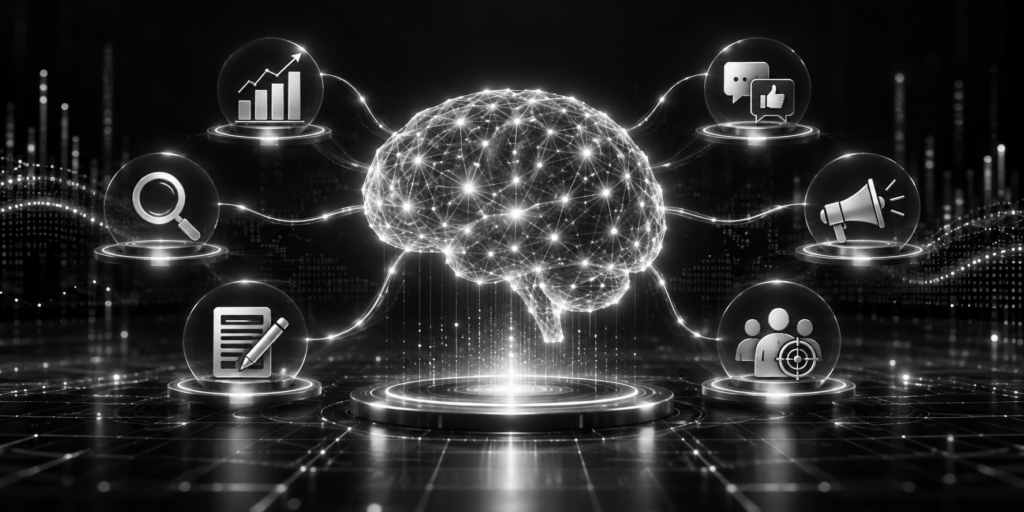
AI in digital marketing is changing how marketers research audiences, create content, manage campaigns, study data, and communicate with customers. Tasks that once required hours of manual work can now be completed more quickly with the support of artificial intelligence.
However, speed is only one part of this change. AI is also influencing how marketers make decisions and what skills they need to develop.
Artificial intelligence can support the marketing process, but it does not remove the need for strategy, creativity, accuracy, and human understanding.
AI Makes Marketing Research Faster
Research is an essential part of digital marketing. Marketers need to understand their audience, competitors, industry, keywords, and customer questions before creating a campaign.
AI tools can help organize large amounts of information, summarize provided material, identify patterns, and generate possible research questions.
For example, a marketer exploring a new audience might use AI to create an initial list of:
Customer challenges
Possible search queries
Content interests
Buying concerns
Campaign angles
Survey questions
These suggestions can accelerate the early research process. However, they should be tested against reliable sources, customer feedback, search data, and actual business information.
AI can suggest possibilities, but it cannot automatically confirm that every suggestion reflects the real audience.
Content Creation Is Becoming More Efficient
One of the most visible uses of AI in digital marketing is content creation. Generative tools can help produce outlines, headline options, caption ideas, email drafts, video concepts, and different versions of advertising copy.
This does not mean marketers should publish the first generated response. Unedited AI content may sound repetitive, provide incorrect information, or fail to represent the brand’s personality.
A better process is to use AI for support:
Define the audience and purpose.
Generate several possible ideas.
Select a useful direction.
Add original knowledge and examples.
Verify important information.
Edit the tone and structure.
Review the final content as a reader.
This approach combines efficiency with human judgment.
Personalization Is Becoming More Practical
Different customers have different needs. A new visitor may need basic information, while a returning customer may be ready to compare options or make a purchase.
AI-supported systems can help businesses organize audiences and deliver more relevant messages based on available data. Personalization may influence:
Product recommendations
Email content
Website experiences
Advertising messages
Offers
Follow-up communication
Useful personalization should improve relevance without making people feel monitored. Businesses must handle customer information responsibly and respect consent, privacy, and applicable data-protection requirements.
Personalization should serve the customer rather than simply increasing the amount of tracking.
Digital Advertising Is Becoming More Automated
Advertising platforms increasingly use machine learning to support bidding, audience selection, placements, creative combinations, and campaign optimization.
Automation can process more signals than a marketer could review manually. It can help platforms adjust campaigns towards a selected objective, such as leads, purchases, or website visits.
However, the marketer remains responsible for important decisions:
Selecting the correct business objective
Defining a valuable conversion
Providing accurate tracking
Creating suitable messages
Reviewing lead quality
Controlling budgets
Protecting brand reputation
If the campaign is optimized for the wrong action, automation may produce more of an outcome that does not genuinely help the business.

AI Supports Faster Data Analysis
Marketing platforms can produce large amounts of information. A campaign may include impressions, clicks, engagement, sessions, conversions, costs, and revenue.
AI can help summarize this data and highlight unusual changes or possible patterns. For example, it may identify that one audience segment has a stronger conversion rate or that mobile users leave a particular page more often.
These observations can guide further investigation. Still, correlation does not always prove cause.
If website traffic decreases, several explanations may be possible. Search demand could have changed, tracking might be incorrect, a campaign may have ended, or competitors may have become more active.
AI can surface a pattern, but marketers must interpret it within the correct context.
Customer Service Is Becoming More Immediate
AI-powered chat systems can provide quick responses to frequently asked questions, guide users to relevant information, and collect basic details before a human conversation begins.
This can help businesses offer support outside normal working hours and reduce repetitive enquiries.
However, automation should have clear limits. Customers need access to a person when the issue is complex, sensitive, or unusual.
A chatbot that repeatedly misunderstands the customer can damage trust. The best system uses automation for simple tasks while allowing smooth human support when necessary.
SEO Work Is Changing
AI can assist with keyword grouping, content outlines, metadata ideas, competitor-page summaries, and technical issue explanations.
These uses may make SEO research more efficient. However, publishing large amounts of generic AI-generated content is not a reliable strategy.
Search-focused content still needs to:
Match the user’s intention
Provide accurate information
Offer genuine value
Use clear headings
Demonstrate useful experience
Work well on mobile devices
Connect naturally with related pages
AI can help create the structure, but the marketer must provide relevance, judgment, and originality.
Beginners can also read my simple guide to SEO to understand the fundamentals before using AI tools.
Visual Creation Is More Accessible
AI-supported design tools allow marketers to generate concepts, edit backgrounds, resize content, create variations, and explore visual directions quickly.
This is especially helpful for students, freelancers, and small businesses with limited resources.
However, generated visuals should be reviewed carefully. Problems may include incorrect text, unrealistic details, inconsistent branding, or images that look too similar to existing content.
Design accessibility has improved, but strong visual communication still requires an understanding of audience, hierarchy, balance, and brand identity.
Marketing Skills Are Also Changing
AI does not make marketing knowledge unnecessary. Instead, it increases the importance of several skills:
Strategic thinking
Clear communication
Data interpretation
Audience understanding
Creative direction
Fact-checking
Ethical judgment
Prompt writing
Quality control
Knowing how to operate a tool is useful, but understanding why a marketing decision should be made is more valuable.
Marketers who combine technology with strong fundamentals will be better prepared than those who depend entirely on automation.

Risks of AI in Digital Marketing
AI creates opportunities, but marketers should also understand its limitations.
Common risks include:
Inaccurate information
Generic or repetitive content
Copyright concerns
Privacy problems
Biased output
Loss of brand voice
Excessive automation
Misleading images or claims
Dependence on tools
Every AI-generated output should be reviewed before it reaches the public. Businesses should also create clear rules for how team members use customer information and generated content.
Businesses can review UNESCO’s guidance on the ethics of artificial intelligence to better understand responsible AI use.
Final Thoughts
AI in digital marketing is making research, content creation, personalization, advertising, analytics, customer service, and design more efficient.
Yet successful marketing still depends on understanding people. AI can process data and generate options, but it cannot replace genuine empathy, business context, or responsibility.
I see AI as a working partner rather than a complete solution. The best results come from allowing technology to handle repetitive work while people focus on strategy, creativity, relationships, and better decisions.
The future of digital marketing will not simply belong to those who use the most AI. It will belong to those who know where AI adds value—and where human judgment matters more.